


Ceylon Tea History
The Timeless Tale of Ceylon Tea
A Legacy Brewed in the Hills of Sri Lanka Nestled in the misty highlands of what is now Sri Lanka, a story of transformation and resilience unfolds—one that begins not with tea, but with coffee. This is the story of Ceylon Tea, a name that has echoed through the tea-drinking world for over a century, synonymous with rich aroma, golden hues, and timeless tradition.
Before the First Leaf: Coffee’s Rise and Fall
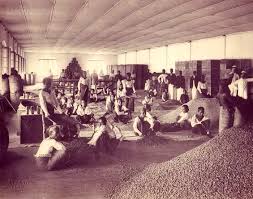
In the early 1800s, during British colonial rule, the central hill country of Ceylon (as Sri Lanka was then known) was blanketed not in tea, but in coffee. British Governor Sir Edward Barnes championed the expansion of coffee plantations, offering land at low prices and building roads from Kandy to Colombo to streamline trade. For a time, Ceylon thrived as a coffee exporter.
But nature had other plans.
In the 1870s, a ruthless fungus “coffee rust” swept through the plantations, bringing the booming coffee industry to its knees. Desperate to recover, planters experimented with cocoa and cinchona, but pests wiped out those crops too. The future of agriculture in Ceylon seemed uncertain until tea took root.
The Birth of an Empire in a Cup
Tea had quietly arrived on the island much earlier, in 1824, when a few plants from China were brought to the Royal Botanical Gardens in Peradeniya. But it wasn’t until 1867 that history truly began to steep.
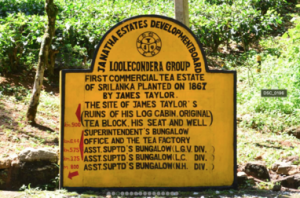
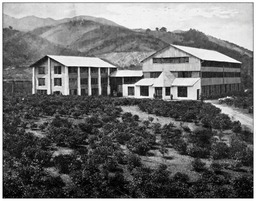
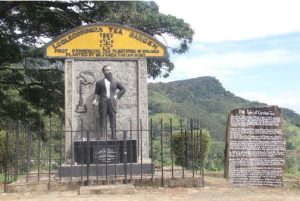
That year, a 17-year-old Scotsman named James Taylor laid the foundation for a new chapter by planting 19 acres of tea in the Loolecondera Estate in Kandy. With vision, grit, and an understanding of the land, Taylor built the first commercial tea factory in 1872, setting in motion a revolution that would change the face of Ceylon forever.
Just a year later, in 1873, the first shipment of Ceylon tea left the island for London. It was the beginning of a global love affair.
Growth, Innovation, and Global Recognition
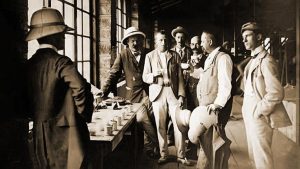
By the 1880s, tea had swept across the island like a green wave. The hills that once held coffee were now adorned with neat rows of tea bushes. Innovators like Henry Randolph Trafford brought expertise from India, while inventors such as Samuel Cleland Davidson and John Walker & Co. mechanized production with devices like the Sirocco dryer and the first tea rolling machines.
In 1883, Colombo hosted its first public tea auction, a milestone in turning tea from a commodity into a celebrated brand. That same year, at the Chicago World’s Fair, the world took its first deep sip of Ceylon Tea. By the late 19th century, over 400,000 acres were under cultivation, and Sri Lanka was on its way to becoming the tea capital of the world.
Ceylon Tea: A Global Icon
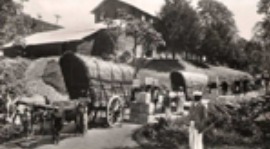
The 20th century only deepened Ceylon Tea’s roots in global culture. The Ceylon Tea Traders Association was formed in 1894, and by 1927, Sri Lanka was producing over 100,000 metric tons of tea each year.
Scientific innovation helped too. The establishment of the Tea Research Institute in 1925 introduced new pest control techniques and improved crop yields, including biological methods to combat threats like the Tea Tortrix caterpillar.
As world wars, market shifts, and political changes came and went, tea remained a constant. A silent witness to history, steaming from cups across continents.
Nationalization and the Spirit of Ceylon
In the 1960s and 70s, amid waves of nationalism, the Sri Lankan government nationalized over 500 plantations. The Sri Lanka Tea Board was established in 1976 to regulate quality and market the product globally.
Yet despite political change, the legacy of “Ceylon Tea” remained untouchable. Even after independence in 1948 and the country’s official name change to Sri Lanka in 1972, the brand “Ceylon Tea” endured protected for its global reputation for excellence, purity, and flavor.
The introduction of instant tea and CTC (crush, tear, curl) processing in the 1960s and 1980s kept the industry competitive and innovative, appealing to modern tastes while preserving tradition.
A Heritage that Brews On
Today, Ceylon Tea stands as more than just a beverage, it is a cultural emblem, a source of national pride, and a testament to resilience. Whether enjoyed in elegant teacups in Europe or over conversations in Sri Lankan households, Ceylon Tea is a connection to the land, to history, and to the people who made it all possible.
From the first experimental saplings in a garden to the shelves of supermarkets and specialty stores around the world, the journey of Ceylon Tea is a story of adaptation, passion, and enduring quality.
And as the sun rises over the hills of Nuwara Eliya and mist curls over rows of green, the spirit of James Taylor and the legacy of Ceylon Tea live on in every brew, in every sip, and in every heart it warms.
Enjoy the Unique Tastes of Seven Regions in Every Sip
Nuwara Eliya, renowned as Sri Lanka’s premier tea-producing region, stands as the highest and most mountainous of all the tea districts. It’s cool climate and elevated terrain create the perfect conditions for cultivating teas with an exceptional bouquet. The tea brewed from this region is the lightest and palest among all Ceylon teas, featuring a subtle golden hue and a fragrant, delicate flavor. Among the most prized varieties are the whole-leaf Orange Pekoe (OP) and Broken Orange Pekoe (BOP), which are especially sought after for their quality and taste.
Dimbula is a high-grown tea district located between Nuwara Eliya and Horton Plains, with all tea estates sitting above 1,250 meters (4,000 feet). The region’s varied landscape creates unique microclimates, resulting in subtle flavor differences, often with hints of jasmine and cypress. Despite these variations, all Dimbula teas share a common character: a smooth, mellow taste and a bright golden orange color in the cup.
The Uva district, tucked away in a remote part of Sri Lanka, is uniquely influenced by both the northeast and southwest monsoon winds. These natural conditions give Uva tea its distinct character and exotic aroma. It was tea from this region that Thomas Lipton famously used to introduce tea to the American market. Known for its mellow and smooth flavor, Uva tea has a taste that’s easy to recognize and hard to forget.
Located near Nuwara Eliya, the Uda Pussellawa district produces tea that shares some similarities with its neighbor but stands out with its own unique traits. The tea here brews a darker, pink-tinged cup with a stronger, tangier flavor. Cooler weather towards the end of the year is said to add a gentle rose note to its aroma, enhancing its medium body and refined character. During periods of heavy rain, the teas become even darker and stronger in taste.
Kandy, the birthplace of Sri Lanka’s tea industry in 1867, produces what are known as “mid grown” teas, as the plantations lie below 1,300 meters in elevation. The flavor of Kandy teas can vary based on altitude and exposure to monsoon winds, but they are all known for their rich taste. These teas brew a bright, copper-colored infusion and are noted for their strength and full-bodied character.
Ruhuna, located in the southern part of Sri Lanka, is known for its “low grown” teas, cultivated at elevations below 600 meters. Spanning from coastal plains to the edges of the Sinharaja Rainforest, the region’s rich soil and warm climate encourage fast-growing tea bushes with long, elegant leaves. Ruhuna is especially known for its bold, full flavoured black teas. The factories here produce a diverse range of leaf styles and sizes, including highly valued golden “tips,” making Ruhuna teas truly distinctive.
Sabaragamuwa, the largest tea-producing district in Sri Lanka, grows “low-grown” teas at elevations from sea level up to 610 meters. Nestled between the Sinharaja Rainforest and the Adam’s Peak wilderness, the region’s climate supports fast-growing tea bushes with long leaves. The tea brews into a dark yellow-brown liquor with a reddish tint, similar to Ruhuna teas. However, Sabaragamuwa’s teas stand out with a distinctive sweet caramel aroma and a smoother, more refined character that adds to their unique charm.